In this guide
“Can you take care of that?” can be a perfectly clear request between people who share the same context. It can be incomplete when one person is new, the situation has changed, or several tasks are in progress. The solution is not to ask every possible question. It is to identify which missing answer could change what you do next.
A useful assignment conversation separates the desired result from the approved way to achieve it. You may understand that an area needs attention while still not knowing which task you are authorized to perform there. Or you may know the method but not whether it takes priority over an existing commitment. Those are different gaps and need different questions.
Find the missing piece
Use four categories as a mental check: outcome, boundary, priority, and authority. Outcome asks what should be true when the assignment is complete. Boundary asks what is included and where to stop. Priority asks how this fits with current work. Authority asks which decisions you can make and who resolves exceptions. You usually need to ask about only one or two.
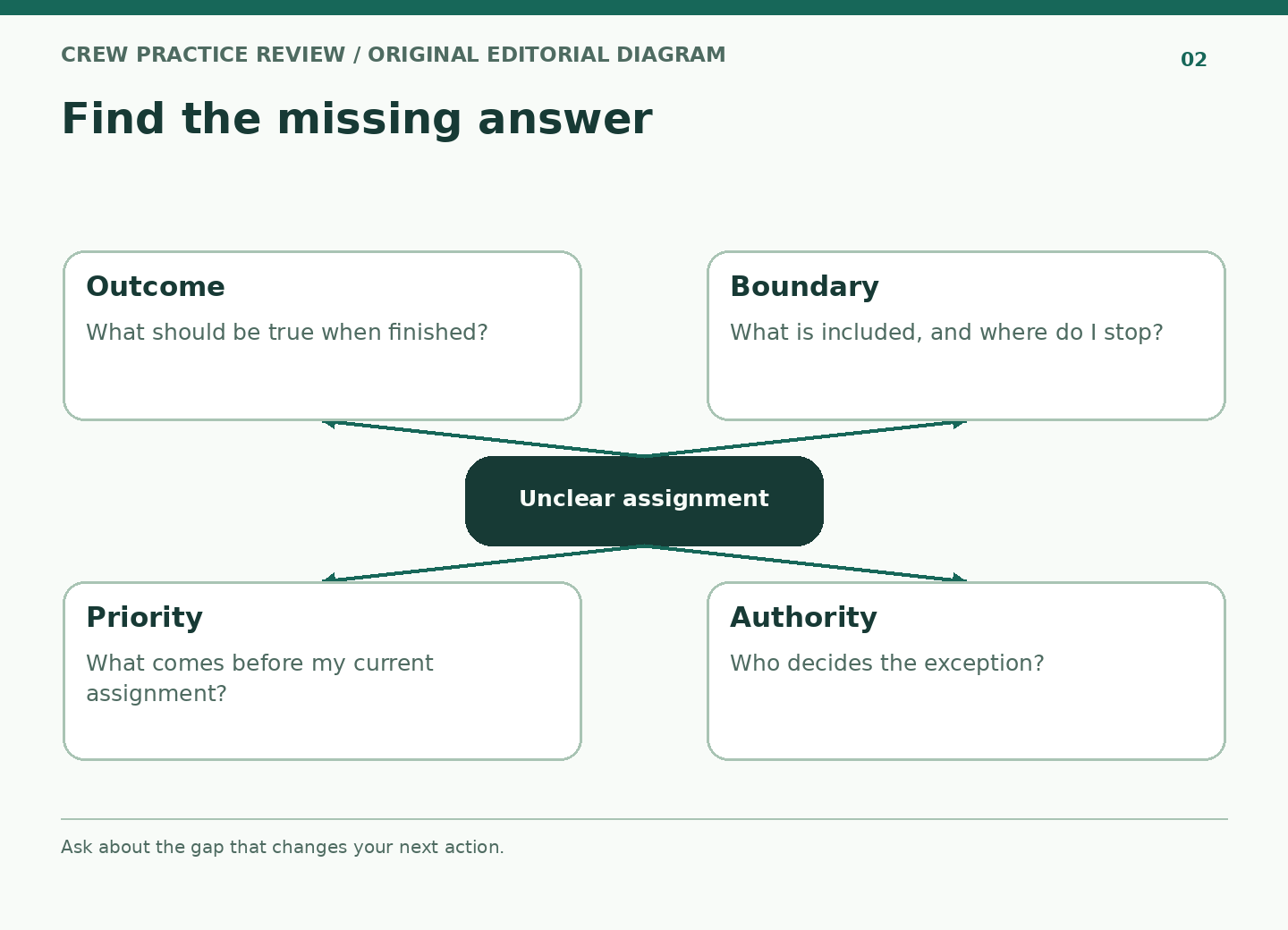
In a hypothetical example, Morgan is working on an assigned routine task when a coworker says, “Help over here when you can.” Morgan understands the location but not the urgency or who has approved the change. Asking, “What should I do?” is broad. Asking, “Should I finish my current assignment first, or check with the shift lead about switching now?” exposes the actual decision.
This is not a script for changing stations at In-N-Out. The employer’s public description includes adapting to instructions and completing assigned work. It does not tell this publication who may redirect an individual associate on a particular shift. That local authority must be confirmed at work.
State what you know, then ask what you do not
A short question is easier to answer when it shows the shared starting point. Try the structure, “I understand X; I need to confirm Y.” For example: “I understand you want a status check on that request; should I report back to you or to the person already handling it?” The question concerns the communication route rather than asking for the entire task again.
Do not use the known part to pretend you understood more than you did. If the method itself is unfamiliar, say so: “I understand the goal, but I have not been shown this task.” That sentence helps the other person avoid mistaking recognition of the goal for readiness to act. Watching someone perform a task is not the same as receiving permission and instruction to perform it yourself.
There is a tradeoff between brevity and completeness. A one-word “Sure” saves seconds but may conceal an unresolved conflict. A long explanation of every concern can hide the decisive question. Aim for the shortest message that contains the current assignment, the new request, and the missing decision when all three are relevant.
Clarify what finished means
“Done” can mean that you completed your part, that another person accepted the handoff, or that the entire request is resolved. Mixing those meanings creates false confidence. If completion depends on a check or an acknowledgment, ask about it before the task disappears from attention.
Suppose a hypothetical associate is asked to find out whether an item is available through the appropriate workplace process. Reporting “I asked” is not the same as reporting “The answer is confirmed.” A precise update would identify the stage: “The question is with the responsible person; I do not have the answer yet.” That protects everyone from treating an inquiry as a conclusion.
Choose a completion question that fits the task. “Do you want me to return with the answer?” checks the reporting step. “Who confirms this is ready for the next person?” checks acceptance. “Is there anything I should leave unchanged?” checks scope. None of these questions establishes the correct food-handling or equipment method; that comes from the actual instruction.
When the person is busy
It is tempting to replace an unavailable answer with a reasonable guess. Before doing that, distinguish a reversible communication choice from an action with safety, food, money, or customer consequences. You might choose a concise way to word a status update within your role. You should not invent an exception, operating method, or assurance merely because the usual contact is busy.
For an ordinary unresolved priority, state the two tasks and request a decision from the person responsible. If no answer is immediately available, follow the workplace’s established process rather than silently switching to an unapproved plan. For a possible hazard or unfamiliar hazardous task, get appropriate help promptly. OSHA’s restaurant resource emphasizes understandable hazard information and training; a publication cannot supply site-specific instruction.
A useful phrase is, “I can continue the part I have been assigned and trained to do, but I need direction on this new part.” Only use that description if it is true and safe in the situation. The point is to make the boundary visible, not to use a stock sentence where immediate emergency action is needed.
Repeat the decision that changes the work
After receiving an answer, briefly confirm the part most likely to be misunderstood. In the hypothetical Morgan example, the response might be, “Finish the current task, then check with the lead before switching.” Morgan can answer, “I’ll finish this and check with the lead before moving.” Repeating the decision is useful; repeating an entire explanation may be unnecessary.
If the answer contains a condition, keep it in the repeat-back. “Do A unless B changes” is not equivalent to “Do A.” The condition may be the most important part. If you do not know how to recognize B, ask for the observable sign. A condition that neither person can identify will not help during the shift.
Review one unclear assignment
After an appropriate learning opportunity, choose one ordinary assignment that required clarification. Write down the original request in general terms, the missing detail, the question you asked, and the answer that changed your action. Leave out private operational records, names, and customer information. The purpose is to improve your questions, not collect evidence about coworkers.
Notice whether your first question was too broad. “What do you mean?” may become “Which of these two tasks is first?” Notice whether you asked too late, after already acting on an assumption. Finally, notice whether the answer really settled the uncertainty. If it did not, the next question should address the remaining gap rather than restarting the whole conversation.
Your practical checklist is short: identify the result; check the boundary; surface a real priority conflict; know who decides; repeat the decisive condition. For incompatible requests, use the conflicting-directions guide. For explaining what you understood without overstating readiness, read teach-back with clear boundaries.
Sources and scope
Public sources checked October 4, 2026. The scenarios and working methods are original editorial examples.
- In-N-Out Burger: Restaurant Job Descriptions — Public expectations for instructions, feedback, teamwork, and task completion.
- OSHA: Young Worker Safety in Restaurants — General restaurant hazards and understandable safety training.