In this guide
When a shift feels slow, “move faster” sounds like a complete answer. It is usually only a description of the desired result. Before changing your pace, ask where the time is going. Are you performing an unfamiliar step? Waiting for a decision? Repeating work after a missed check? Switching between unfinished assignments? Each situation calls for a different response.
This guide treats pace as a property of a reliable sequence. It is independent practice for restaurant associates, including readers researching In-N-Out work. It does not set service-time targets or teach food preparation. The company’s public role description names task completion and teamwork; it does not provide a public timing standard for the exercises below.
See the whole cycle, including rework
Consider a hypothetical paper exercise with two ways of passing a request between people. In version A, the first person takes 20 seconds to send it, but leaves out a required detail. The receiver spends 25 seconds asking and waiting, then 15 seconds revising the record. In version B, the first person takes 30 seconds, including the required confirmation, and the receiver can continue immediately. These invented times illustrate a comparison; they are not measured restaurant performance.
Version A looks faster if you watch only the first person’s movement. Across both people, it consumes 60 seconds of effort and waiting compared with 30 in version B. Real work is more complicated because some tasks overlap, but the lesson remains useful: a local shortcut can move the cost to someone else. Ask whether your change improves the complete handoff or just makes your portion look shorter.
The reverse mistake is adding checks without knowing their purpose. Repeating the same harmless detail three times can create delay without improving understanding. Required checks stay in place. For optional repetition, ask the trainer which check establishes the needed fact and when it is complete. You should not remove a workplace requirement based on your own impression that it is redundant.
Sort the delay before proposing a fix
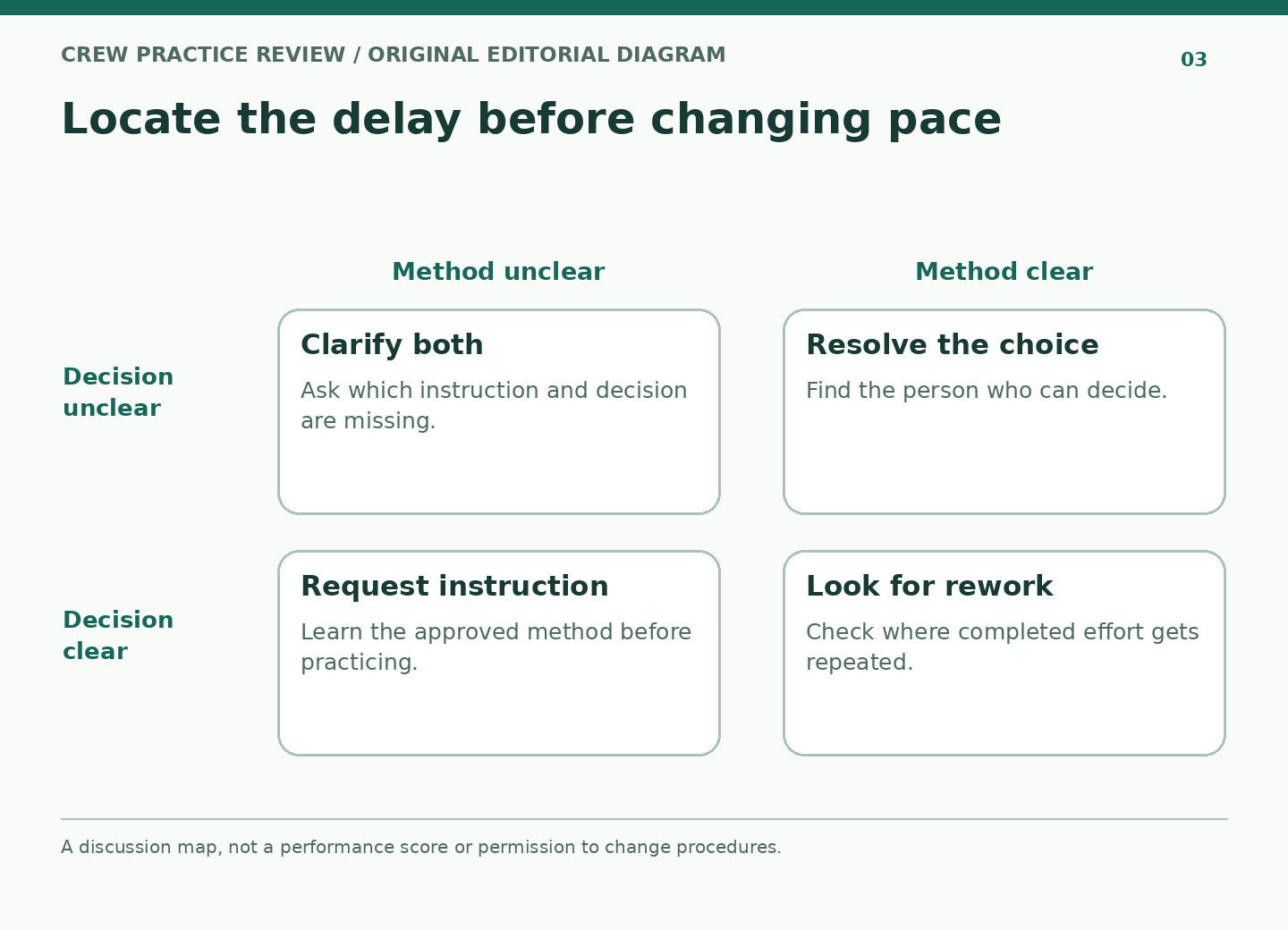
The diagram asks two separate questions: is the approved method clear, and is the next decision clear? When both are clear, examine where work is repeated. When either is missing, address that gap before treating pace as the problem.
- Skill gap: you need instruction or supervised practice on an approved method.
- Information gap: you are waiting for a fact or clarification.
- Priority gap: two assignments compete and someone must decide.
- Rework: an earlier omission or misunderstanding must be corrected.
A hypothetical learner, Taylor, assumes that every delay is a personal speed problem. On review, Taylor finds that several pauses occurred while asking who owned an unresolved question. More practice moving quickly would not supply that ownership decision. The useful change is to confirm the receiver at the handoff. A different learner, who understands the assignment but still needs instruction on the approved method, needs a different conversation.
Do this review using general observations and an appropriate workplace discussion, not secret timing of coworkers. You do not need a stopwatch or a productivity score. “I had to ask who was taking this next” is already enough to identify a question. Personal notes must respect workplace rules and privacy.
Locate the checkpoint that prevents a costly assumption
A checkpoint is a moment where the next action depends on something being true. The receiver understands the open request. A supervisor has chosen between competing priorities. The learner has the required instruction. The current information has been verified through the authorized route. These are general examples, not a replacement for the checks in your actual procedure.
Ask your trainer, “Which point should I make sure is correct before moving on?” The answer may reveal a dependency you did not notice. Then ask what evidence is enough. A nod from someone who did not hear the question may not mean that responsibility transferred. An item looking familiar may not mean its details have been confirmed. Reliable pace depends on knowing the difference.
When you feel pressured, use the required checkpoint as an anchor rather than inventing a faster method. OSHA identifies restaurant hazards and the need for safety information and training. No speed goal in this article justifies bypassing those protections. Report a concern promptly through the appropriate process instead of treating it as a personal efficiency challenge.
Improve the space between required steps
Once the approved method and checks are clear, look for an ordinary communication improvement around them. You might ask your trainer whether you can state a pending question earlier, combine two related status facts into one update, or clarify the next assignment before completing the current one. The proposal should be specific enough for the responsible person to approve, adjust, or reject.
For example, Taylor proposes, “When I report that this part is ready, could I also name the unresolved question in the same update?” The trainer can say whether that fits the actual workflow. This is a better experiment than deciding to rearrange work areas, batch food tasks, change equipment use, or eliminate a check. Those changes involve operational knowledge and authority the exercise does not provide.
Tradeoffs should stay visible. Earlier communication may reduce a surprise but interrupt someone who is handling a more urgent issue. A longer handoff may avoid follow-up questions but overwhelm the receiver. The right question is “What does this person need at this point?” rather than “How can I always speak less?” or “How can I always move more?”
Review the attempt without ranking people
After an authorized change, compare the same feature: Did the receiver still need to ask who owned the question? Did the assignment remain unresolved because the priority was unclear? Were required checks preserved? You are reviewing whether the change solved the stated problem. You are not proving that you are faster than another associate or that a single shift establishes a trend.
If the change did not help, avoid adding another shortcut immediately. Revisit your explanation of the delay. Maybe the receiver was clear but the decision-maker was unavailable. That would call for a different reporting route or supervisor decision, not a shorter sentence. Failed attempts can still teach you which assumption was wrong.
Take one focused question to the next conversation
Prepare three lines: “The delay I noticed was…”, “The part I have already checked is…”, and “The change I would like guidance on is…”. A completed hypothetical example is: “I had to repeat the same status update to two people. I know who assigned the work, but not who receives the final update. Which person should I report to first?”
Use the rework-pattern method for recurring errors and the capacity-request guide when the actual issue is more assigned work than you can safely complete. Good pacing is not silently absorbing every new request. It is making progress that other people can rely on, with unresolved limits visible early enough for a responsible decision.
Sources and scope
Public sources checked October 4, 2026. The scenarios and working methods are original editorial examples.
- In-N-Out Burger: Restaurant Job Descriptions — Public expectations for instructions, feedback, teamwork, and task completion.
- OSHA: Young Worker Safety in Restaurants — General restaurant hazards and understandable safety training.