In this guide
Repeating work can feel like evidence that you are not improving. Sometimes it reveals a much narrower problem: a missing detail, an unclear handoff, a condition you did not recognize, or a method you still need help learning. Find the point where the first attempt became incomplete before deciding that the answer is simply more effort.
Start with a few specific events
Use general, privacy-safe examples you can describe accurately. A hypothetical learner notices three occasions when a receiver asked, “Who is taking this next?” The learner had included the current status each time, but had left ownership implicit. Those events suggest a possible handoff pattern. They do not establish that every handoff is poor or that one coworker is responsible.
Compare that with a different hypothetical learner who repeats work because the original request lacked a required detail. The visible outcome is similar: extra questions and another attempt. The underlying learning need differs. The first learner needs to clarify ownership; the second needs to identify the missing detail before beginning.
Map the earliest unresolved point
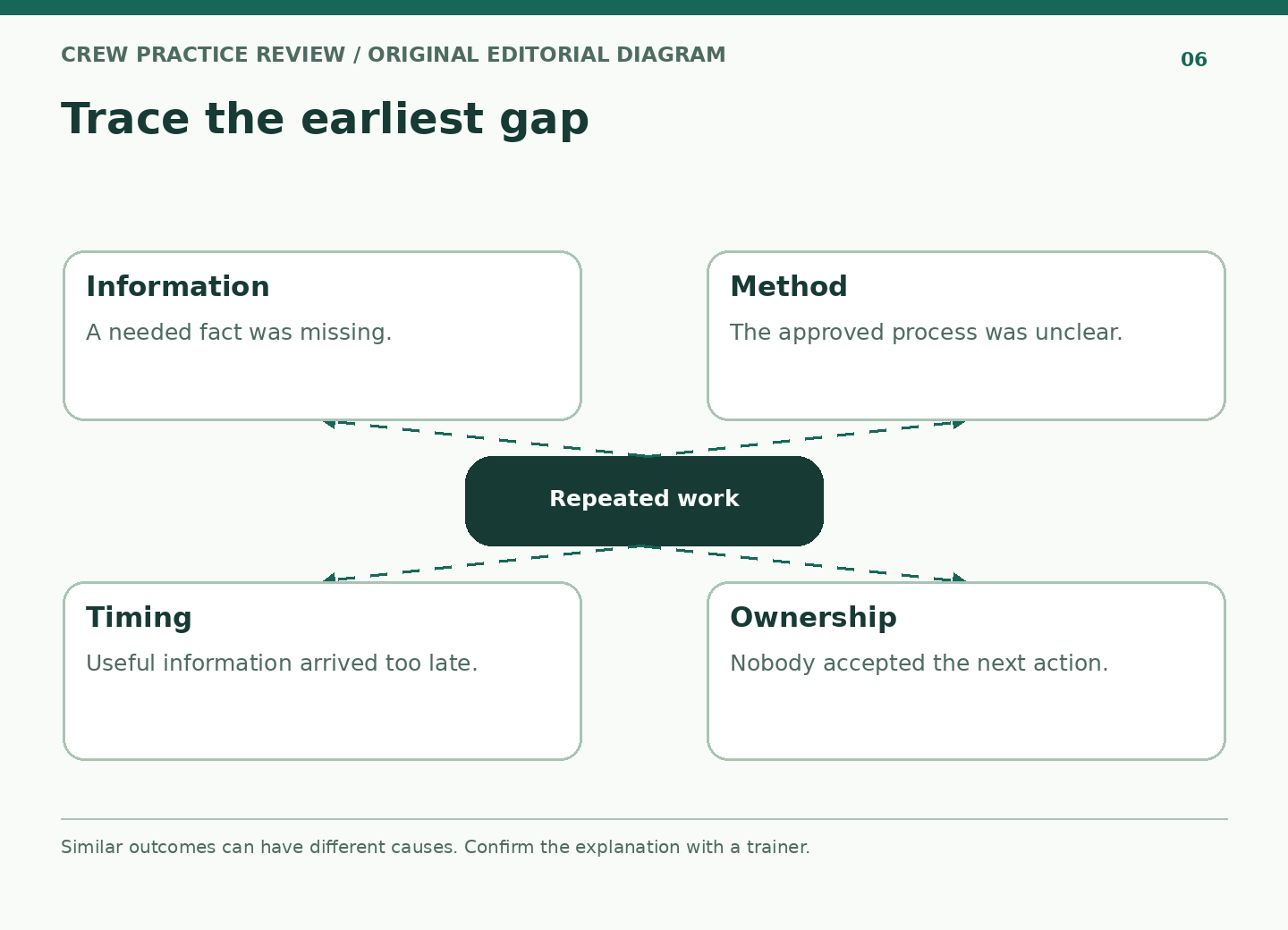
- Information: Was a needed fact missing or assumed?
- Method: Was the approved process unclear or not yet learned?
- Timing: Did useful information arrive after someone needed it?
- Ownership: Was the next action left without an accepted receiver?
These categories are editorial prompts, not a diagnostic system. An event can involve more than one. Start with the earliest gap you can support from observation because later problems may depend on it. If you are uncertain, bring the example to a trainer rather than deciding the cause alone.
Avoid false patterns
Three similar outcomes do not automatically have the same cause. One missing answer may result from an unclear question, another from a changed situation, and another from an unavailable decision-maker. Preserve those differences. Grouping everything under “communication” can be too broad to change anything.
Also consider how many opportunities you had to use the skill. Two repeated errors in two attempts mean something different from two errors among many varied attempts, but neither figure should become a personal performance rating without context. You do not need to collect counts about coworkers or time their work. The goal is a useful question about your own learning.
Test the explanation with a bounded change
For the hypothetical ownership pattern, the learner asks the trainer, “Would explicitly naming the next receiver address the gap you noticed?” If that fits the approved process, the learner tries it during an appropriate assignment. The next check asks whether the receiver still had to reconstruct ownership. It does not ask whether the entire shift became faster.
If the same problem returns, inspect what remained missing. Naming a receiver may not establish that the receiver accepted the work. The next refinement may be acknowledgment, not more emphatic wording. This is why the handoff guide separates ready, received, and resolved.
Know when a learning experiment is the wrong response
Do not repeat a potentially unsafe action to see whether the pattern happens again. Do not test new food-handling, chemical, equipment, payment, or exception procedures based on this article. Required corrections and safety concerns belong in the workplace’s trained process. The pattern method is for reviewing ordinary learning and communication within your authorization.
Similarly, repeated lack of required instruction is not something a private log can fix. State the missing preparation and its practical effect to the responsible person. A learning framework can improve the question, but it cannot create supervision, staffing, or permission where those are absent.
Finish with a question you can use
Write, “In these examples, the recurring gap seems to be ___. What should I do at that point?” Keep “seems” if the cause is not confirmed. Then record the answer and the next authorized attempt in a small learning log. Success means you understand the next action more clearly, even before the whole skill feels easy.
Sources and scope
Sources checked October 4, 2026. Examples and methods are original editorial work.
- In-N-Out Burger: Employment FAQs — Public training commitment; no personal timetable or guaranteed opportunity.