In this guide
A handoff can sound complete while leaving the most important question unanswered: who is taking the next action? “I mentioned it” describes what the sender did. It does not establish what the receiver understood or agreed to handle. Reliable coordination requires enough shared understanding for the next person to continue without reconstructing the entire situation.
That does not mean every transfer needs a long report. Many routine exchanges are brief because the people involved already share the context. The challenge is to recognize when an exception, unfinished question, or change of ownership needs to be stated explicitly. This is an independent communication framework, not In-N-Out’s internal handoff procedure.
Use four fields, not a transcript
A useful transfer contains the current state, the open point, the next action, and the receiving owner. The current state is what has actually been completed or confirmed. The open point is what remains uncertain. The next action is what needs to happen, within the receiver’s authority. The owner is the person or role that accepts responsibility under the workplace’s process.
In a hypothetical service situation, Alex has clarified what a guest is asking but cannot decide the requested exception. An unhelpful handoff says, “There’s a problem over there.” A more useful transfer says, “The guest is asking whether that exception is possible. I clarified the request but haven’t promised an outcome. Can you take the decision from here?” The actual workplace determines who can decide and how the transfer occurs.
Notice the value of stating what has not happened. “I haven’t promised an outcome” prevents the next person from assuming a commitment exists. It is not necessary to recount every sentence of the exchange. Include the boundary that could affect the next action, then let the receiver ask for relevant detail.
Separate ready, received, and resolved
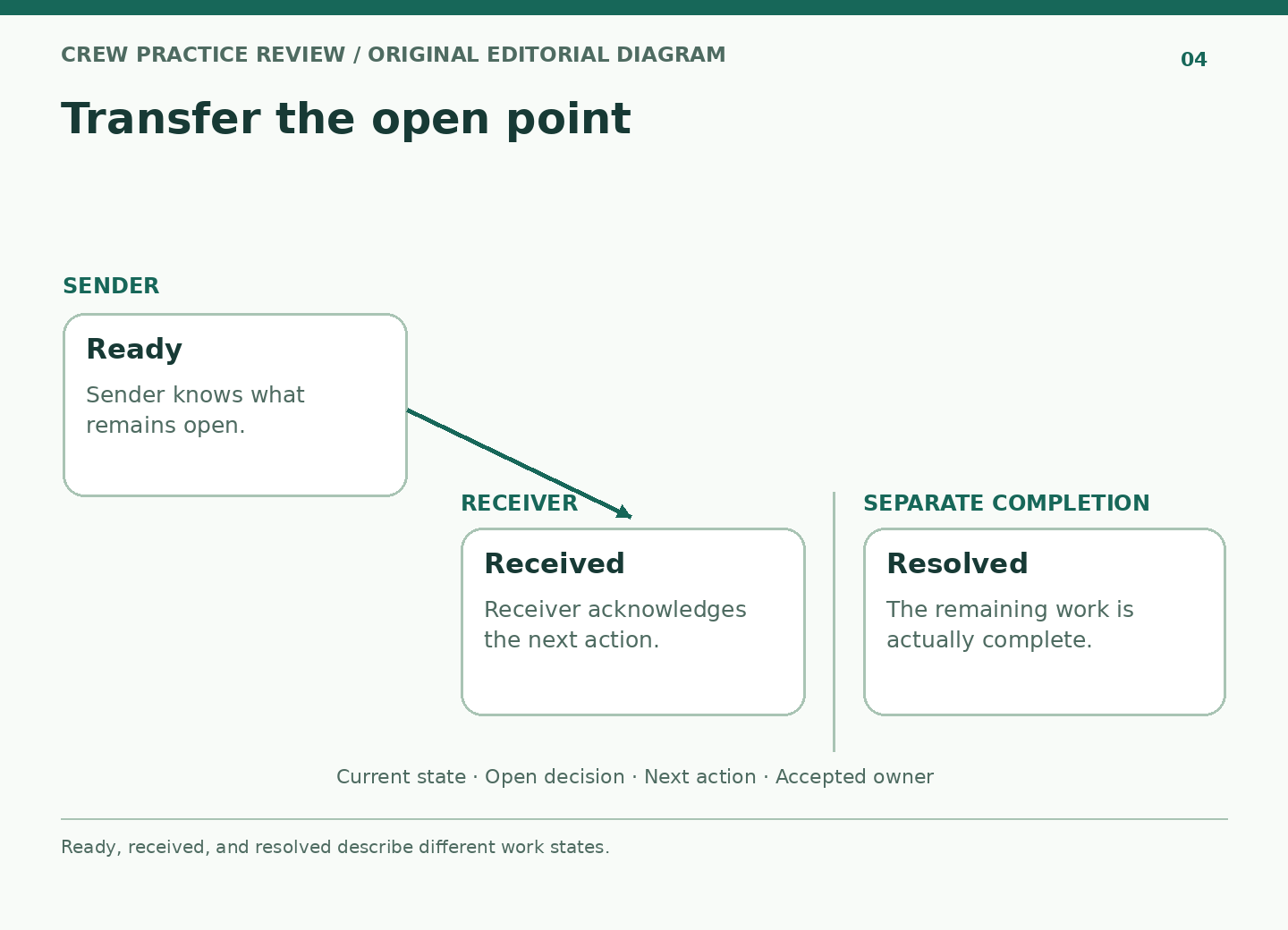
These three words describe different stages. Ready means your part can be transferred. Received means the next person has acknowledged the transfer. Resolved means the remaining decision or work is complete. You should not use one as a substitute for another merely because the conversation moved on.
Suppose Alex says a request is “handled” after informing a supervisor who is occupied elsewhere. The supervisor may reasonably think Alex completed it; Alex may think the supervisor owns it. The resulting gap comes from a status word that concealed the transfer. “I have the request ready for you, but haven’t confirmed you can take it yet” is less polished and much clearer.
This distinction matters for ordinary work as well as service exceptions. A question sent is not an answer obtained. A task started is not a task completed. A concern reported is not a hazard corrected. Use the most accurate state you can support, especially when someone else might act on your summary.
Check receipt at the level the situation requires
A routine exchange may need only the workplace’s usual acknowledgment. A complex exception may require the receiver to state the next step. Do not turn every handoff into a test of your coworker. Ask a practical question such as, “Is there anything else you need to take this?” or “Should I remain the contact until you are available?”
The answer may reveal that the person heard you but cannot take ownership. That is useful information, not a failed conversation. Follow the established route for finding the appropriate receiver. Do not interpret politeness, proximity, or an overheard comment as an agreement to take responsibility.
In-N-Out’s public job description emphasizes productive teamwork. The framework here is one editorial way to examine a team exchange. It does not authorize a reader to assign work, change staffing, leave a position, or decide that an associate has accepted duties without confirmation.
Choose details by what they change
Background belongs in a handoff when it affects the next decision. A guest’s requested outcome may matter. Your personal opinion of the guest usually does not. The fact that no remedy has been promised matters. A full retelling of how frustrated you felt may obscure that fact. Keep the transfer factual, respectful, and limited to what the work requires.
Protect private information. Do not move health details, payment information, identifiers, or coworker issues into a personal note or informal group chat for convenience. Use the authorized channel and share only the necessary information with the appropriate person. If you are unsure which channel is appropriate, ask before copying the material.
For the hypothetical Alex example, compare two versions: “They are being difficult and have asked three people” versus “The request has not been resolved; they are waiting for an authorized answer.” The second version helps the receiver act without inheriting a judgment about the person. If prior contacts affect the actual decision, describe them neutrally and only to the extent needed.
When nobody can take it immediately
An unavailable receiver is a coordination problem to make visible. State the pending work and ask the responsible supervisor for the next arrangement. Avoid inventing a promise that the receiver will arrive at a certain time. You may be able to say you are seeking help, but you cannot guarantee another person’s availability.
If a concern is urgent, follow the urgent route rather than waiting for the ideal handoff. OSHA’s worker-participation guidance recommends ways to report hazards and follow up on concerns. This supports the general importance of a reporting loop; it does not specify any employer’s chain of command or replace emergency procedures.
A useful ordinary status sentence is, “This is still waiting for a decision; I have not confirmed a new owner.” It may feel uncomfortable to admit that a transfer is incomplete, but it gives the supervisor an accurate picture. Declaring completion to relieve social pressure simply hides the unfinished work.
Practice both sides of the exchange
For a voluntary paper exercise, write a fictional request with one completed step and one open question. As the sender, prepare a two-sentence transfer. As the receiver, identify the current state and your proposed next action. Then inspect whether the two versions match. Keep the exercise generic and free of private workplace information.
Try a second round in which the receiver lacks authority. The correct result is not to force acceptance; it is to identify who can decide and preserve the unresolved status. Try a third round in which the sender has made an assumption. The receiver’s question should expose that assumption before it becomes a false fact.
Before a real handoff, check: What is complete? What remains open? Who can take the next action? Has that person actually received it? Afterward, use a concise status update if the situation changes. For the longer boundary between work periods, read shift-transition notes, which separates operational closure from personal end-of-shift reflection.
Sources and scope
Public sources checked October 4, 2026. The scenarios and working methods are original editorial examples.
- In-N-Out Burger: Restaurant Job Descriptions — Public expectations for instructions, feedback, teamwork, and task completion.
- OSHA: Worker Participation — Safety-program reporting and follow-through recommendations.