In this guide
A correction can leave you with two very different kinds of information: how the moment felt, and what you should do differently. Both matter, but only the second tells you how to change the next attempt. The practical challenge is to turn a broad comment into a behavior you can observe without inventing the standard yourself.
In-N-Out’s public Store Associate description includes receiving constructive feedback and working cooperatively. It does not publish a script for every correction. This guide offers an independent way to make a learning conversation concrete. It is for general restaurant work, with actual task methods and authorization supplied by your workplace.
Name the gap before defending the effort
Imagine a hypothetical associate, Jordan, who hears, “Your updates are too vague.” Jordan remembers trying hard to communicate and wants to explain every interruption. That response might convey effort, but it does not yet reveal what a useful update would contain. A better opening is a specific question: “Which detail would have helped you decide what to do next?”
Suppose the answer is that Jordan announced a delay without saying what was waiting or who needed to decide. The learning target is now much smaller than “be a better communicator.” It is “state the unresolved item and the decision needed.” Jordan can try that change during the next appropriate update and ask whether it made the situation clearer.
Listen for the distinction between a result and a behavior. “The handoff was confusing” describes an outcome. “You said it was finished although one question was open” identifies a behavior. If the feedback only names the outcome, ask for an example. If it names several behaviors, ask which one to work on first. You are narrowing the work, not negotiating away the concern.
Build a four-part feedback loop
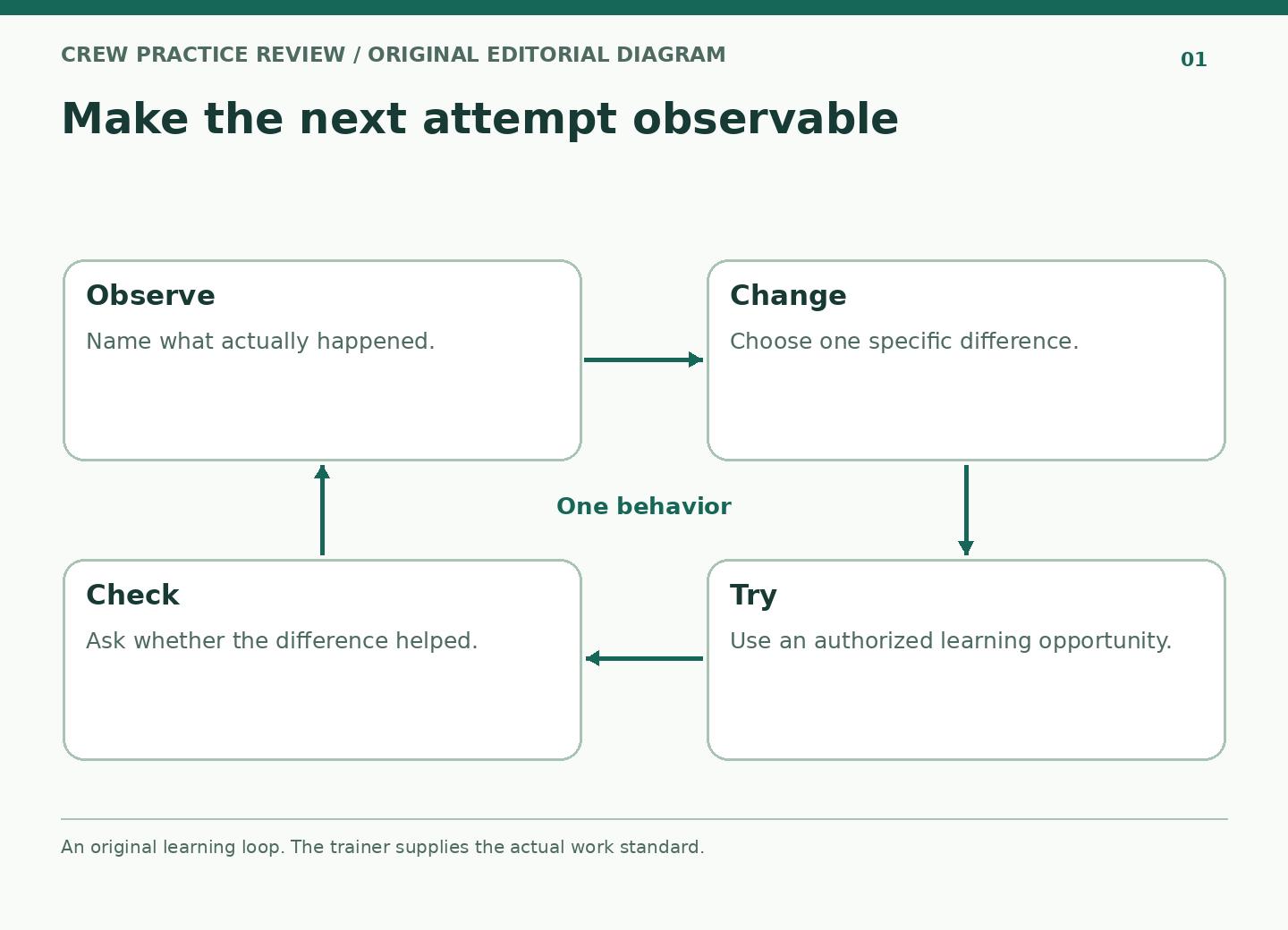
- Observed moment: what happened that the other person actually saw or heard?
- Required difference: what should happen at that point instead?
- Next attempt: where can you try that difference within your assignment?
- Check: how will you know whether the change met the expectation?
For Jordan, the loop reads: “My update named a delay but no pending decision. Next time I will identify the unfinished point and who needs to decide. At the next suitable handoff, I will ask whether the receiver has enough information.” This is an editorial learning record, not a company evaluation form or a promise of advancement.
Keep the check close to the behavior. If the target is clarity, “I felt less nervous” is useful personal information but not evidence that the receiver understood. “The receiver accurately stated the open decision without another explanation” is closer to the target. That does not prove every future update will work; it gives the next conversation something specific to examine.
Compare three responses to the same correction
Consider the hypothetical comment, “You need to keep people informed earlier.” One response is, “I always tell people.” That turns a particular event into a debate about your whole character. Another is, “Okay, I’ll do better.” It is cooperative but leaves the threshold for “earlier” undefined. A third is, “In that situation, which change should prompt me to tell you?” This asks for a usable decision point.
The third response is not always the right sentence in the middle of urgent work. If someone is directing an immediate safe correction, follow the authorized instruction first and save the detailed learning discussion for a suitable moment. The important distinction is between making the current situation safe and understandable, and analyzing the pattern afterward. A complete analysis should not delay an urgent response.
Once there is room to talk, you can explain relevant constraints. “I had two requests with different priorities” may be important context. Pair it with the learning question: “What should I communicate when that happens again?” This allows the supervisor to clarify both your action and the allocation of work, rather than making you personally absorb an unresolved conflict.
Change one variable when that is safe and practical
Suppose Jordan changes the timing, length, wording, and recipient of every update at once. A later improvement might be real, but it will be difficult to identify what helped. For an ordinary communication skill, choose one clear change first: name the pending decision before giving background. Keep the required workplace process intact while testing that change.
This is not a reason to preserve an unsafe or incorrect method as an experiment. Required corrections take effect when instructed. The one-variable idea applies to optional refinements within a method you are authorized to use. It is especially useful when a learner is trying to solve everything at once and cannot remember the next practical action.
Also avoid turning someone else’s fluent style into your standard. A more experienced coworker may know context you have not yet learned. Ask what must be conveyed and what can be shortened. Copying their brevity without understanding their shared knowledge can remove the very detail your own receiver needs.
When you do not understand or agree
You can receive feedback professionally without pretending that every statement is clear or accurate. Separate the part you can act on from the part that needs clarification. “I understand the open item should be stated. I thought I had passed it to Lee; can we check where the transfer became unclear?” addresses the event without accusing either person of bad intent.
If the feedback is about a personal label, redirect toward observable work. “What action would you want to see differently?” is more useful than trying to prove you are naturally fast, confident, or committed. If the issue involves mistreatment, discrimination, safety, or another serious concern, a personal learning exercise is not the whole response. Use the appropriate workplace or external support route for that issue.
Close the loop without asking for constant reassurance
A focused check might be, “I included the unresolved point in that update. Was the next action clear?” It is easier to answer than “Am I doing okay?” Ask at a suitable moment and respect the person’s availability. The goal is a useful observation, not a rating after every small action.
Record the result only as specifically as the evidence allows. “One handoff was clearer after I named the owner” is honest. “I have mastered handoffs” is premature. The company’s employment FAQ describes a commitment to training and development, but public language does not set your personal evaluation criteria or timeline.
Before your next learning conversation, check four things: Can I describe the event without a character judgment? Can I state the requested difference in one sentence? Do I know where I may practice it? Do I have a question that checks the result? If any answer is missing, ask about that gap. Use the learning-log method to keep the record compact, and the rework guide if the same problem keeps returning.
Sources and scope
Public sources checked October 4, 2026. The scenarios and working methods are original editorial examples.
- In-N-Out Burger: Restaurant Job Descriptions — Public expectations for instructions, feedback, teamwork, and task completion.
- In-N-Out Burger: Employment FAQs — Public training commitment; no personal timetable or guaranteed opportunity.